Before you start: open the Steam page of any free game and look at the category list. In our checks on October 4 and October 16, 2026 (UTC), all 22 Steam listings we read carried the "In-App Purchases" flag. That tells you the game sells something inside it. It does not tell you what, how much, or whether it changes how well you can play. This guide covers what each common model sells and how to set a spending line before you open a shop. Not hands-on tested: every claim below comes from a cited source.
What Steam's In-App Purchases flag tells you
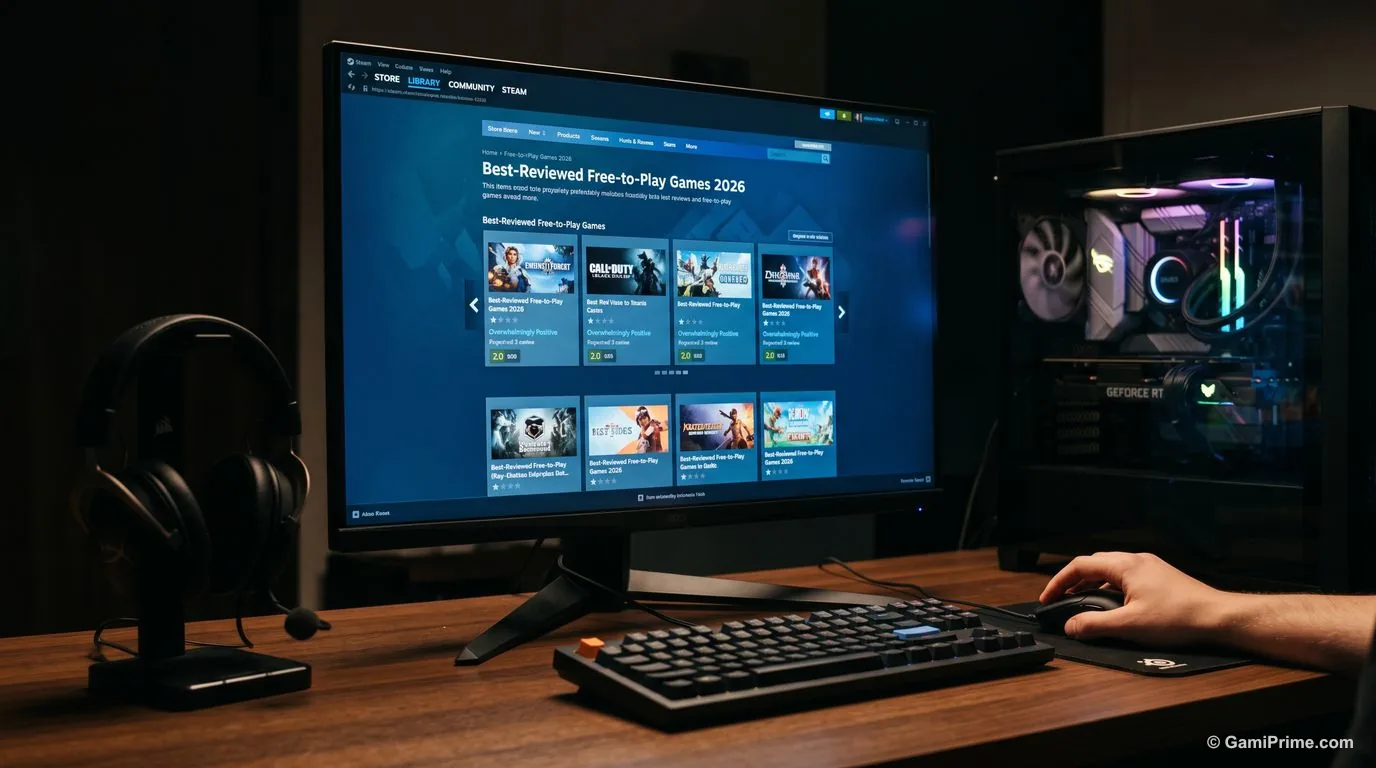
The flag means the game offers purchases inside it. It does not describe them. Every free game we looked at carries it, from shooters to strategy games, so the flag alone cannot separate a cosmetic-only shop from one that sells power.
Do this: treat the flag as a prompt to look further, not as a verdict. Read the store description for what the publisher claims, then look at what players say, which our review pillar below covers.
Model 1: gacha pulls
A gacha game sells randomized rewards. Wikipedia describes the mechanic as using "randomized loot tables with in-game rewards of differing value", where players exchange in-game currency for "pulls" or "spins" and premium currency is bought with real money (Wikipedia, Gacha game).
Two examples from the games we cover. Wikipedia describes Zenless Zone Zero as a free-to-play action RPG where players summon Agents for use in combat through gacha mechanics (Wikipedia). It describes Wuthering Waves as having banners called Convenes, where Resonators and Weapons can be obtained, with a pity mechanism that guarantees 5-star items within a set number of pulls (Wikipedia).
Pity is a safety net, and each game sets its own numbers. Wikipedia describes soft pity (rising odds after a threshold), hard pity (a guarantee after a fixed number of pulls) and sparking (a currency that lets you pick an item after enough pulls). Check the game's own help page for its exact numbers, because they differ by game.
Common mistake: assuming "free" means "no pressure to spend". A gacha shop sells chances at characters that are used in combat.
What regulators have required
Regulators have focused on odds, currency and minors. Wikipedia reports that in many jurisdictions item rarities must now be public, that China has required odds disclosure since 2017, and that Japan banned "complete gacha" in 2012 (Wikipedia, Gacha game).
In the US, the Federal Trade Commission announced on January 17, 2025 a settlement with Cognosphere Pte. Ltd and Cognosphere LLC, doing business as HoYoverse, over Genshin Impact. The company agreed to pay $20 million. The FTC alleged that it deceived players about the odds of winning five-star loot box prizes and about the cost of winning them. The order bars children under 16 from buying loot boxes without parental consent, and requires the companies to disclose loot box odds and virtual currency exchange rates (FTC press release).
That case concerns one publisher and one game. We cite it to show what a clear disclosure looks like, not to judge any other game.
Model 2: battle passes and cosmetic shops
A battle pass sells a season of cosmetic rewards for a one-time price. Wikipedia describes the Marvel Rivals battle pass as purchasable each season with Chrono Tokens, and says that once bought it no longer expires. It also describes Lattice, a premium currency obtained through achievements, events, the battle pass or real money, used for cosmetics (Wikipedia, Marvel Rivals).
The same article says the game has been praised for a monetization model without pay-to-win elements, because all gameplay elements such as heroes are free. That is a description of reception, not a guarantee for every item.
Model 3: cosmetic-only claims
Some publishers state outright that they sell only cosmetics. The Where Winds Meet Steam page says there is no pay-to-win and that monetization is limited to cosmetic items. That is the publisher's claim. We have not verified it, and a claim on a store page is not an audit.
Where the question stays open
For strategy and collection games such as Infinity Kingdom, Project Entropy and RAID: Shadow Legends, the Steam descriptions we read do not say what the shop sells. We did not find a sourced description of their monetization, so we do not describe it here. Open the in-game shop and read recent reviews before you spend.
Set a spending line before you open the shop
Decide the limit first, then look at prices.
- Pick a monthly amount you would not miss, and write it down.
- Check whether the game shows its odds and the real-money cost of its currency. If you cannot find them, treat that as a reason to wait.
- Look for what the shop sells: cosmetics, characters, time savers, or items that change power.
- Use your own card or platform controls to cap spending, especially on a shared device.
- If a child plays, review who holds the payment method.
The models side by side
One table, four models: what each sells, a sourced example, and what to check.
| Model | What it sells | Example from our sources | What to check |
|---|---|---|---|
| Gacha pulls | Randomized chances at characters or gear | Zenless Zone Zero, Wuthering Waves (per Wikipedia) | Odds page, pity rules, real-money price of one pull |
| Battle pass | A season of cosmetic rewards | Marvel Rivals (per Wikipedia) | Whether the pass is cosmetic, and whether it expires |
| Cosmetic-only shop | Looks, no power (publisher claim) | Where Winds Meet (Steam page claim) | Whether the claim holds in the shop |
| Not described | Unknown from the sources we read | Infinity Kingdom, Project Entropy, RAID: Shadow Legends | The in-game shop and recent reviews |
Where to go next
For which games to try first, start from the genre map of free PC games. To see how players rate the games you are considering, use the Steam review ranking.
Frequently asked questions
How do free-to-play games make money?
By selling items or chances inside the game. Common models are randomized pulls (gacha), battle passes and cosmetic shops. Steam flags all of these as "In-App Purchases".
What does Steam's "In-App Purchases" flag mean?
That the game offers purchases inside it. It does not say what they are. All 22 Steam listings we checked (13 on October 4, 2026, UTC, and 8 more on October 16, 2026, UTC) carry it.
Are gacha games gambling?
Regulators treat them differently. Wikipedia reports that the EU, Belgium and the Netherlands increasingly regulate gacha as gambling-like, while the UK does not classify it as gambling because items have no real-world monetary value. The FTC action above concerned odds disclosure and minors in the US.
Is a game with a battle pass pay-to-win?
Not by that fact alone. Wikipedia describes the Marvel Rivals pass as cosmetic and the game as praised for having no pay-to-win elements. Check each game's shop for what it sells.
Sources
- Wikipedia, Gacha game
- Wikipedia, Zenless Zone Zero
- Wikipedia, Wuthering Waves
- Wikipedia, Marvel Rivals
- FTC, Genshin Impact developer settlement, January 17, 2025
- Where Winds Meet on Steam, read October 4, 2026 (UTC)
Last verified: 2026-10-04. Wikipedia statements are attributed to Wikipedia and were not independently checked.