You are looking at a season timer counting down and a reward track you have not fully seen, and the question is whether to pay before it resets. A battle pass is not one fixed thing: Wikipedia's general description of the format and the one GamiPrime-tracked game with a sourced, specific battle pass (Marvel Rivals) do not even agree on whether the pass expires. The mechanic is real and documented. The specifics are set by each publisher, game by game, and this guide does not invent them for games where no citable source states them.
Not hands-on tested: GamiPrime has not purchased or played through a battle pass on any tracked game. Every mechanic below is attributed to the source that describes it.
What a battle pass actually is
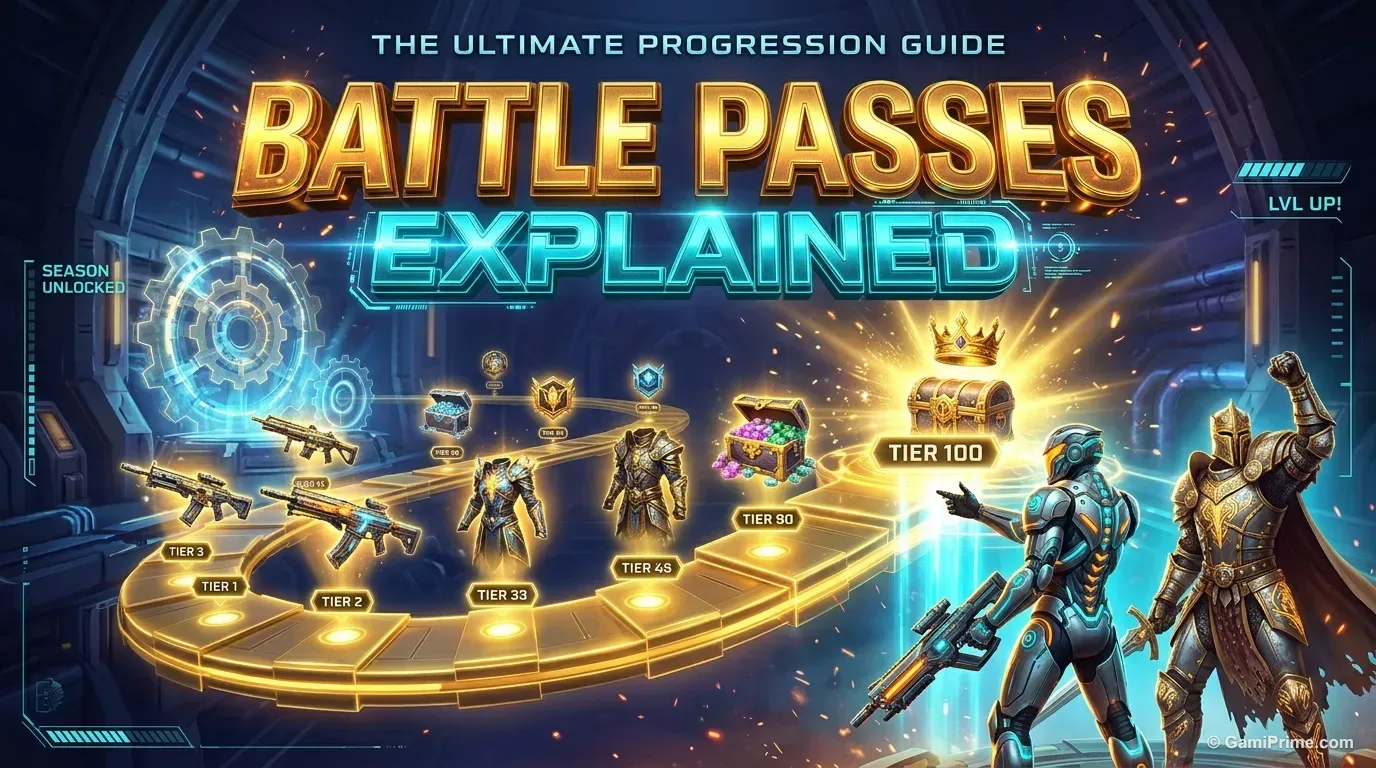
A battle pass is a season-long reward track you unlock by earning experience through play, split into a free tier open to everyone and a premium tier you pay to access. Wikipedia describes the basic model: once obtained, "the battle pass presents the player with a number of reward tiers," unlocked by earning experience points, typically through "completing challenges and playing matches" (Wikipedia, Battle pass).
The free track exists in most of the games Wikipedia describes, but it is not the same offer as the paid one. Wikipedia reports that free passes commonly have "a very limited number of tiers or offer fewer or less-desirable rewards" than the premium pass, and that in some games, progress made on the free track carries over if a player buys the premium pass later in the same season.
Rewards are "typically cosmetic in nature," Wikipedia says: skins, emotes, banners, sprays. Some games replace the tier-by-tier structure with reward blocks or a currency you spend inside the pass instead.
Do this: before you look at the price, find the game's own page describing what tier 1 and the final tier contain. A pass with its full reward list visible up front is a different purchase than one that reveals rewards as you climb.
The part that makes a pass different from a one-time purchase: the clock
Battle passes are seasonal, and most rewards disappear with the season. Wikipedia states that battle passes and the rewards they contain "are only available for a limited time, most commonly a few months," and that "most battle pass items are unobtainable after the season ends." A few games break this pattern: Wikipedia names Halo Infinite as a title where old, already-released passes stay purchasable rather than vanishing.
Designers also have to size the grind to the season length. Wikipedia reports that Halo Infinite's battle pass was criticized for taking too long to finish relative to typical play time, and that the developer said it would recalibrate progression. In some games, spending real money is one of the ways to speed that climb.
The clock is also the one thing that is not standard across games. Marvel Rivals is the one tracked GamiPrime game with a specific, sourced battle-pass rule, and it runs opposite to Wikipedia's general pattern above: Wikipedia's Marvel Rivals article states that "once the player purchases a battle pass for the season, it will no longer expire" (Wikipedia, Marvel Rivals). That single sourced example is also the clearest illustration of why "battle passes expire" cannot be stated as a universal rule: it depends on the publisher, and the only way to know is to read that game's own notice.
Common mistake: assuming every battle pass works like the last one you bought. Season length, expiry and catch-up mechanics are set per game. Marvel Rivals' own season length changed over time, too: Wikipedia reports that seasons were originally planned to run three months each, split into two halves, before moving to two-month seasons from Season 3 onward.
Why a reward track is built to feel urgent
The format uses documented psychological tactics, not accidents of design. Wikipedia's Battle pass article lists several, while flagging that the underlying claims need outside citation: unlocking a tier is built to feel like an achievement; challenges are often small, repeated tasks players complete without noticing; season-exclusive rewards create what the article calls "artificial scarcity," so players feel pressure to play before the season ends (the FOMO effect, short for "fear of missing out"); and players can feel they must finish a pass to get value from time already spent, "even if their enjoyment of the game decreases over time" -- the sunk-cost pattern.
Wikipedia also records criticism of the model on the same page: that it is "seen by some as predatory" because the best rewards sit at the end of the track, pushing players to either spend more money to skip tiers or put in long hours; that it exploits FOMO because pass-exclusive cosmetics often never return; and that in multiplayer games it can shift play itself, with some players reported to chase challenges that advance their pass rather than play to win the match. The same article notes criticism of Overwatch 2 for locking new heroes, not just cosmetics, behind its pass -- which drew pay-to-win criticism before Blizzard changed that policy.
None of this means a given pass is designed in bad faith, and GamiPrime is not asserting that about any specific tracked game here. It means the season timer and the visible tier count are themselves part of what you are being sold, separately from the cosmetics.
What Steam's own flag does and does not tell you about a battle pass
GamiPrime's monetization pillar checked the Steam store pages of 14 free-to-play games on October 4, 2026 (UTC) and found the "In-App Purchases" category flag on every one of them. That flag does not distinguish a battle pass from a gacha shop, a cosmetic-only store, or a currency pack: it only says the game sells something inside it. If a Steam listing's own system-requirements or category row names a battle pass directly, that is a stronger signal than the general flag, but most listings do not spell out the mechanic at that level of detail. Read the publisher's own season or store notice for what their pass actually contains.
Checklist: five questions before you buy a battle pass
Answer these before you open your wallet, not after the season is half over.
| Question | Why it matters |
|---|---|
| Can I see the full reward track before paying? | A visible tier list lets you judge the pass on what it contains, not on a promise of good rewards later. |
| Does it expire? | Wikipedia's general pattern is that most passes and their rewards vanish at season's end; Marvel Rivals is a documented exception once bought. Check the specific game. |
| What happens if I do not finish it? | Some games let unfinished free-track progress carry forward if you buy premium later in the same season; others do not say. |
| Does finishing it require extra spending, or just time? | Per Wikipedia, slow-paced passes can push players toward paying to skip tiers rather than only playing more. |
| Am I buying this because of what it contains, or because the timer is running out? | The FOMO and sunk-cost tactics Wikipedia documents are built to make the second reason feel like the first one. |
Check this: if you cannot answer the first two questions from the game's own store page or official notices, that is itself useful information. Treat an unanswered question as a reason to wait, the same rule GamiPrime's pay-to-win checklist applies to unclear shop items.
If that does not work: close the storefront, play the free track for a session, and come back once you have seen what the free rewards actually are. A pass does not stop being purchasable because you waited a day.
What this guide did not find
GamiPrime did not find a citable official source describing battle-pass specifics (price, exact tier count, or expiry rule) for any other tracked free-to-play game beyond Marvel Rivals. Several Steam listings in GamiPrime's catalog carry cosmetic-shop or season-pass language without enough detail to cite a mechanic, and third-party price trackers found during research disagreed with each other across seasons, which is why none of their figures appear in this article. Where GamiPrime has not verified a game's specific battle pass, this guide does not describe one.
Where to go next
For the other monetization models free-to-play PC games use besides battle passes, see GamiPrime's guide to how free-to-play games make money. For a Steam-sourced roundup of which free-to-play PC games to try first, see the best free-to-play PC games of 2026.
Frequently asked questions
Do all battle passes expire?
Not universally. Wikipedia's general description says most battle passes and their rewards are "only available for a limited time, most commonly a few months," with Halo Infinite's older passes as a named exception that stay purchasable. Marvel Rivals is a separately sourced exception where, once bought, the season's pass "no longer expires." Check the specific game; do not assume either pattern.
Is a battle pass pay-to-win?
Not by default: Wikipedia describes most battle pass rewards as cosmetic. Overwatch 2 is a documented exception where new heroes were locked behind the pass, which drew pay-to-win criticism before Blizzard changed the policy. If a pass locks anything beyond cosmetics, that is the detail to check before buying.
What does Steam's "In-App Purchases" flag tell me about a battle pass?
Only that the game sells something inside it. It does not say whether that purchase is a battle pass, a gacha pull or a cosmetic shop item. GamiPrime's check of 14 free-to-play Steam listings on October 4, 2026 found the flag on all of them, with no distinction between models.
Why does a battle pass feel urgent to finish?
Wikipedia's Battle pass article attributes this to documented design tactics: tier unlocks built to feel like achievements, small unnoticed challenges, season-exclusive rewards that create scarcity (FOMO), and the sunk-cost feeling that time already spent obligates finishing the track.
Sources
- Wikipedia, Battle pass
- Wikipedia, Marvel Rivals
- GamiPrime, "How Free-to-Play PC Games Make Money" (Steam In-App Purchases check across 14 listings, October 4, 2026; linked above)
Last verified: 2026-10-16. Wikipedia statements are attributed to Wikipedia and were not independently checked.